Trigger warning for pregnancy loss and miscarriage, but think it needs to be said:
The past two days, I’ve been wondering, if a nationwide abortion ban comes, whether I will have to fly to Canada to get the reproductive healthcare I need, if and when we try again for pregnancy, and if I miscarry again.
A nationwide abortion ban can now happen in (at least) two ways: 1. the FDA authorization of the medicines required for abortion and late-term miscarriages is revoked, and 2. The 1873 Comstock Act is enforced by SCOTUS to not allow mailing of abortion materials. If those happen, NY, California, and all the places that have enshrined abortion rights will no longer have those rights. This is all outlined in Project 2025. Trump has the Senate now, may have the House, and has this power; SCOTUS is conservative, and Trump has the power to appoint two younger SCOTUS members if Alito and Thomas resign, which the nation would live with for decades to come.
This is no longer theoretical.
My miscarriage started six months ago Tuesday in Montreal. My husband and I sat in the emergency room as I leaked out the rest of my amniotic fluid at 17 weeks. Though our baby had a heartbeat, the doctors all agreed that there was no viable chance for survival. I was also developing an infection. The doctors recommended I be induced for labor or have surgery. Against doctors’ orders, we flew back to NY the following day to deliver my baby here. The care I needed so I wouldn’t die required the medicines now possibly on the chopping block, and the tools for D&C to remove my placenta that may no longer be mailed to the hospital. Without this care, I could have died like Josseli Barnica did in 2021 in Texas. She was also 17 weeks pregnant as she miscarried and as her baby still had a heartbeat like mine. Her doctors refused to treat her for 40 hours because of the abortion laws there.
I know now Montreal and Canada would have provided the care I needed had I stayed there. It is no longer a guarantee that we’ll have that level of care in NY or anywhere in the US soon. And as I PPROMed once already, there is a higher likelihood now that, in a future pregnancy, this can happen again. This is not me catastrophizing: this is real.
So, for those saying Trump is like the rest, no, he’s not. A lot of people are going to suffer needlessly because of this election. And I am only talking about one issue. I am scared, I am nervous, yet I am oddly calm, because I now know what’s coming. We have no choice but to fight back. A lot of work is to come.
I finished the first draft of my memoir a few months ago and am revising now, hooray! So why don’t I feel spectacular?
Because this memoir writing is often lonely and painful. Yes, writing is a solitary act, but solitude is not what I’m referring to. I’m talking about the loneliness that comes from writing my lived experience.
A few weeks ago, I had a call with my dad about my memoir-in-progress (and yes, Dad still calls me every day):
“Nei5 se2 hou2 bun2 syu1 mei6 a?” Dad asked. I understood why he was asking this: I resigned from teaching last summer, have been writing full-time while leading workshops for high school students and adults, and told Dad I would ‘work’ again when I was done with a ‘good-enough’ draft of the book.
“Mei6 a!” I responded and laughed. Did he know—did anyone know—how long it took to write a book? “Nei5 jau5 mou5 se2 go3 bun2 syu1 a?” Had he ever written a book? I had finished the first draft, and Dad thought that meant I was done, but revisions and rewrites are needed before I dare show the book even to my husband, let alone a stranger.
“Ngo5 dim2 sik1 duk6 syu1 a?” Dad replied, belittling himself. Yes, I had never seen him pick up a book and read. But that didn’t mean he didn’t know how to read a book: I know how he scours through the Chinese newspaper every day.
Still, I know my parents won’t ever read my book, at least in the form I wrote it in if translated.
My parents don’t speak English, and English is the only language I am fluent in.
To share our conversation above, I used jyut6 ping3, a Cantonese romanization and tonal pronunciation system used for English speakers, because I can’t read many Chinese characters. Dad and Mom can’t read jyutping, and they can’t read this writing.
In speaking with fellow storytellers, readers, writers, activists, friends, and community members about my childhood experience, there’s always shock and surprise among monolingual speakers (i.e. English-only speakers) on how I am not fluent in my parents’ Chinese languages of Cantonese and Toisan. Here are the most common questions well-meaning people ask:
How did that happen? I want to ask back, what language is our school system in? What language do I need to speak to survive in America? English. And what were my immigrant parents focused on when they arrived to America and had us three kids? Survival. My parents didn’t need to learn English in Chinatown or at their workplaces, but they pushed us to learn English. They needed us to do bare-bones translations at appointments, of mail, and, yes, even our own parent-teacher conferences. But they were too tired from work, or some cultural silences and taboos had to be kept to speak much Chinese to us. Then, at school, when I did attempt to speak my Cantonese and Toisan, the kids made fun of my tones because, news alert, the tones you use when pronouncing the words change the meaning. AHH! So I was not incentivized to speak my Chinese languages.
So how fluent are you actually in Cantonese and Toisan? Yes, it’s not like I don’t know any Cantonese or Toisan. But my vocabulary is lacking. I don’t understand even the kids’ shows on TVB (believe me, I’ve tried). Some people ask what my Cantonese level is: I think it’s around the level of a first- or second-grader in Hong Kong. I dare say, everyone who’s multilingual, like my friend Michele Carlo who did a November show with me on this topic, would not be surprised. My English as a New Language teacher training taught me that we all have varying levels of fluency in our languages. We also have differing levels of receptive language (reading and listening) and expressive language (speaking and writing). So many kids who grew up with me in Chinatown would not call themselves fluent in their parents’ languages, and their parents don’t know English. Michele isn’t fluent in Spanish, either.
So how do you communicate with your parents? You have to communicate with them somehow. My parents and I talk with each other, but we can only speak in basic conversational language when talking to one another: food, work, sleep, relationships, etc. Now there are dictionary apps and resources I use to translate on the fly if needed, which did not exist when I was growing up. But we rarely have long or deep conversations.
I realized in this writing process that I’ve never been able to dream of a different kind of linguistic relationship with my parents. I have an active and lifelong mental block on what I can and cannot say to my parents. I can’t even verbalize all the questions I want to ask them; my body, mind, and heart won’t take the disappointment of not being able to understand their responses (if they were to share) and being let down again. I wish I could push this mental block away like Toph would, but a lifetime of longing is not easily remedied.
Unsurprisingly, I chose to spend a decade in special education classrooms in predominantly immigrant neighborhoods, specifically Sunset Park, Brooklyn, and Little Village, Chicago, where many of the students are also not fluent (yet!) in their parents’ heritage languages. I wanted to encourage my students to embrace their multilingualism and multiculturalism in ways I would have benefited from at their age.
To master a language is to practice it and to speak it. And if we’re not speaking and practicing, we lose that language.
In three years of seriously working on this memoir, I have found only one book-length memoir chronicling the experience of a kid of the immigrant diaspora unable to speak with their parents fluently in the same language. (Please, if you know of one, share! I have asked dozens of memoirists and writers, to no avail.) Julie Sedivy’s “Memory Speaks,” published in 2021, is about an author’s attempt to connect to their home heritage. Sedivy’s “barely functioning Czech” and her father’s poor English, combined with cultural clashes, led to their eventual distance from one another. When Sedivy’s father passes, Sedivy loses her closest tie to her Czech heritage and is eager to reclaim it. Reading this book felt like a balm, especially from an academic describing childhood language acquisition and the idea that not all is lost.
There are essaysonlineaboutthisexperienceforsure, but other than Sedivy’s book, I’ve found nothing book-length that gets at the cultural bereavement of that parental heritage language loss. Yes, there are memoirs like Kat Chow’s “Seeing Ghosts,” or Michelle Zauner’s “Crying in H Mart,” where it is outwardly stated that their characters don’t speak their heritage languages fluently. But they also can navigate their distances in other languages (usually English) to get the fuller story I cannot. (BUT: my friend Grace Loh Prasad will publish one on her heritage language loss next year!)
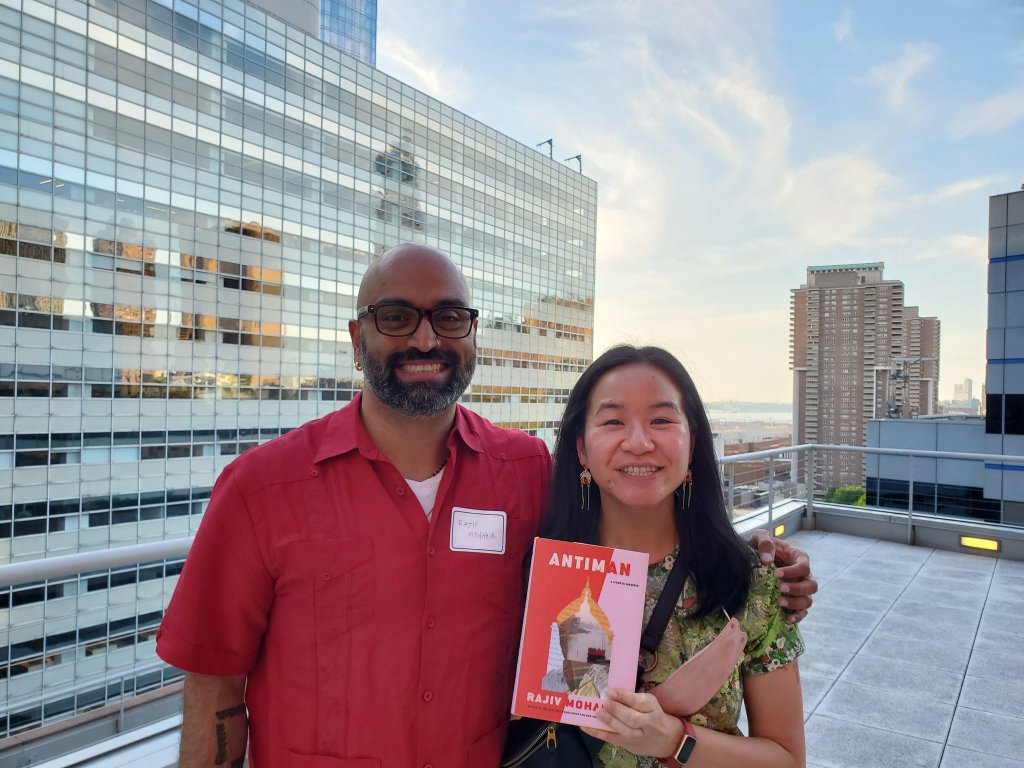
There are other memoirs using heritage languages in their arcs, though. It seems to be more common for children and their grandparents to suffer heritage language divides, like Rajiv Mohabir, the author of the beautiful multilingual hybrid memoir “Antiman.” Mohabir writes about being alienated and attempting to connect with his Aji through heritage languages.
There’s an infuriating assumption made when people read about a character’s non-English language on the page: that they’re fluent in that language. On Friday, I asked Mohabir, “Your experience learning Hindi in Varanasi implies to a reader that you’re fluent in Hindi now. Are you?” Mohabir emphatically shook his head and laugh-said no! He knows, as I do, that language doesn’t work so easily.
“Writing about this language gap with my parents is lonely and painful,” I told Mohabir.
He nodded and tilted his head back. “Thank you for saying that.” I got teary-eyed at the recognition and validation.
Rajiv Mohabir and Annie Tan, holding Mohabir’s book “Antiman,” at the AAARI Asian American Studies Symposium, May 12th, 2023
I think Martha Alderson wrote the lonely feeling I have best:
“when you’re in the flow [of writing], loneliness is not what you’re feeling.
Loneliness comes when you’re uncertain and insecure about what you’re doing. You doubt yourself and feel alone, separate and different from the flow of humanity around you. Isolated, the words refuse to come.
Loneliness often comes from the absence of affection and stems from sadness which is the loss of control over a source of love or attention. In other words, you want something and you feel you can’t have it.”
My linguistic gap with my parents has created a loneliness I’ve felt powerless to traverse. I moved home to New York to be closer to them, and we do have longer conversations now. But there’s a feeling that I’ll never fully break through or reach the kind of relationship I want with them.
Today would have been Vincent Chin’s 68th birthday. I learned through a book by Paula Yoo that Vincent, my cousin, wanted to be a writer, but Lily Chin, his mother and my great-auntie, wanted him to do something more practical with his life.
It is also Vincent Chin, who was murdered in 1982, that I am uplifting in my memoir, as it is his story, in English, that brought me closer to the family history I could not learn in Chinese. It is his story and my great-auntie Lily’s courage that started a historic Asian American movement. And which gave me and so many others the courage to speak.
When I began working on this memoir full-time in September, I cried every week, sometimes a few times a week, because I never fully processed this linguistic part of my lived experience. Just this week, I had a big cry with my husband; the pressure to get this experience right in my memoir is often unbearable.
But I have done this work before, and I can do it again.
I cried, too, over not knowing my cousin’s story, and spent decades looking for my family history. I cried when family members told me to stop looking, to stop talking about Vincent. Kid me would never have dreamed that I would understand the story of my cousin Vincent Chin, or about my great-auntie Lily Chin who shared Vincent’s story over and over again. I would never have dreamed I could talk about the case openly with relatives; though many still don’t want me to speak about Vincent publicly, I feel it’s our duty as family members to keep his legacy alive. I never dreamed I would speak publicly on behalf of our family (and that I would have to).
Maybe I am doing the not-practical thing, as great-auntie Lily said to Vincent, by writing this memoir. But as a friend told me, I’ve imagined a world with my writing in it and made it possible for that to happen, which is a feat in itself. It is a blessing right now to have the savings, support, and my husband’s health insurance to support this task. I am building my writing community: I just spent a month at my first writing residency at the Vermont Studio Center, was waitlisted for the Bread Loaf Writer’s Conference, and will attend the Tin House Summer Workshop in Portland in July as well as the Bread Loaf Writers Conference in Vermont in August! And though I’m away from the classroom for now, writing this memoir is very much still educating.
I must consistently remind myself in this work that I am not alone. It frustrates me that I don’t have many examples for guidance. But as memoirists Chanel Miller and Stephanie Foo said on Monday, we have to focus on that 16-year-old and others who need our book.
I know I’m the only person who can write this memoir, and I know that it will make a difference.
As Toni Morrison said, “If there’s a book that you want to read, but it hasn’t been written yet, then you must write it.”
And I hope my future agent and editors keep the title I want for my book:
“Learning to Speak: A Daughter’s Journey Toward Languages, Activism, & Legacy.”
This blog post is part of the #31DaysIBPOC Blog Series, a month-long movement to feature the voices of indigenous and teachers of color as writers and scholars. Please CLICK HERE to read yesterday’s blog post by Erica Silva (and be sure to check out the link at the end of each post to catch up on the rest of the blog series).
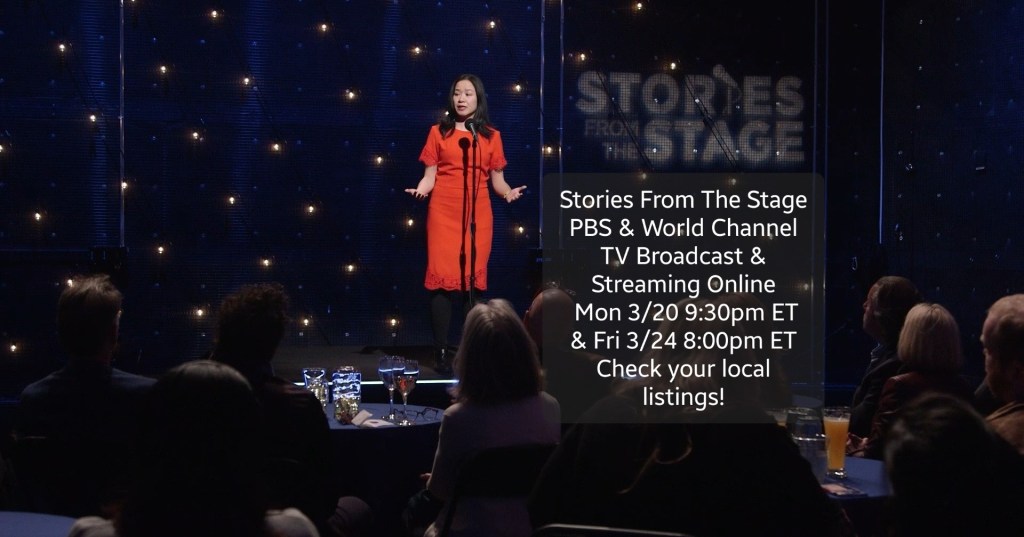
First off: I will be on the PBS & World Channel Show Stories From The Stage, broadcast on TV and streaming online, this coming Monday 3/20 at 9:30pm ET / 6:30pm PT! You can check out the trailer for the show here. I, Elena, and Michelle filmed this in November at WGBH Studios in Boston, and I am so excited for you all to hear our stories. When I told my parents about the airing yesterday, they asked for me to figure out how to configure Channel 13 on their television (and I failed, boo!).
Today I got to speak to some high school students about my family story. Nothing is as inspiring as watching youth be completely engaged with and ask great questions about the legacy of Vincent Chin in general and on my family. In my time away from teaching, I’ve been able to lead multiple workshops with high school students about writing and telling their family stories, and that has been an honor.
I am very close to finishing a first draft of my book: I hope to finish by next week. That will give me a few weeks before a monthlong Vermont Studio Center writing residency from April 9th- May 6th, where I hope to revise the complete manuscript! This comes after two wonderful workshops I was able to take part in 2023 so far: the VONA Winter Writing Intensive with Michael Thomas, and the Tin House Winter Workshop under Sasha LaPointe! I found out two days ago I got into a competitive summer writing workshop, wahoo! I’m super excited to continue the journey toward a completed revised manuscript to send out to agents.
Much love to all the artists and creatives out in the world (and congratulations to Everything Everywhere All At Once, which is a movie that means a lot to me and taught me a lot about what it means to write for a specific audience). I am able to write this academic year because of savings and the health insurance/income coming from my husband, who I married just a little over a year ago. I decided I won’t be returning to teaching elementary special education next year, but I imagine that, at some point in the future, I will return to teaching. I’m not sure yet what’s in store job-wise for the future, but I know this writing journey was the right choice. After I’m done with enough of this memoir, I would like to turn this manuscript into a one-woman show somewhere in NYC; more updates to come! Keep dreaming, everyone, and keep writing.
Hello friends! Since leaving teaching I’ve been memoir writing, applying to writing fellowships and residencies, workshopping parts of this book in storytelling spaces, and working on a book proposal to send out! It’s been an adjustment to build a writing routine and structure, but I feel good investing in myself.
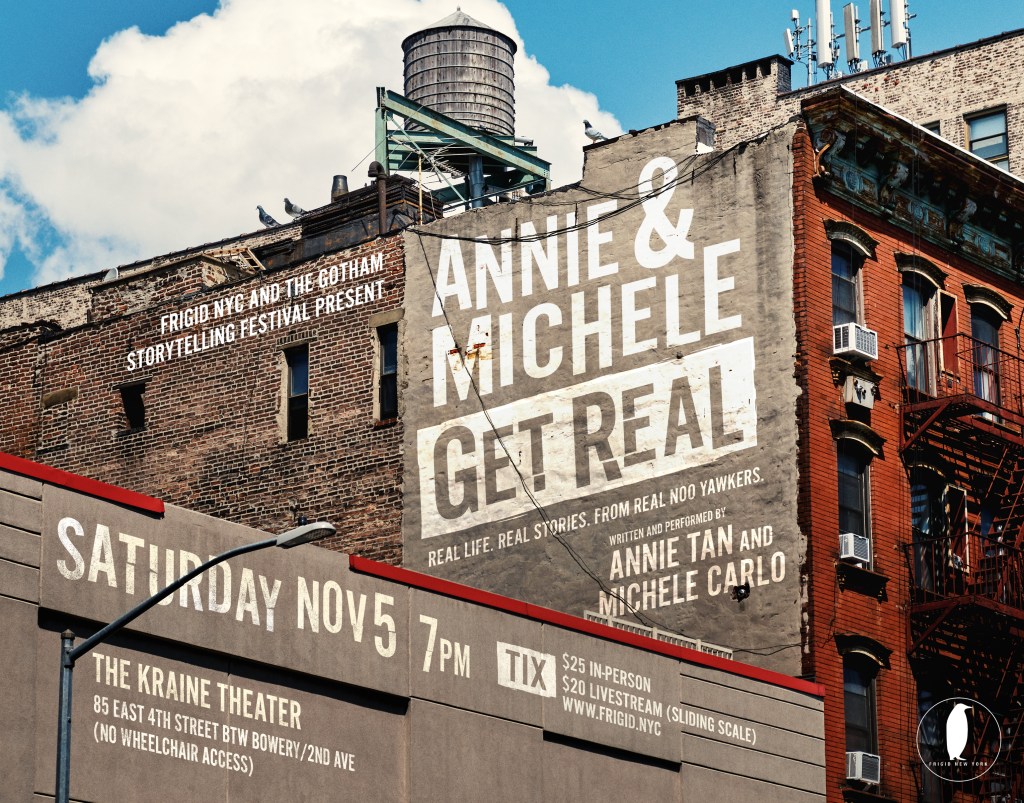
I’m excited to share upcoming events in NYC and Boston in the next week and a half, which are all stories from my memoir! The one I’m most excited about is Annie & Michele Get REAL this Saturday 11/5 at 7pm, both in-person at the Kraine Theater (East Village) and livestreamed, my longest storytelling set yet (20 minutes) and with my good friend Michele Carlo. I’m working out a language arc for my memoir and I hope you’ll join in!
Although I’ve done longer keynote speeches, performances are scary, and I’m hoping to work up to an hour’s worth of material which will be based on my memoir (believe me, there’s plenty of material!). All of these events are also on my updated speaking and events page on my website, which I will add to periodically when I have things coming up. Hope to see you, and would love your feedback!
Upcoming Events
Sat. Nov. 5th, 2022, 7pm: Annie & Michele Get REAL Storytelling Show, Kraine Theater, 85 E 4th St (No Wheelchair access) (TIX: IN-PERSON & LIVESTREAMED)
Annie Tan tries to figure out how to have a relationship with her immigrant parents when they literally don’t speak the same language: they don’t speak English and she’s not fluent in Chinese.
Everything around Michele Carlo is getting old: her family, her cats — and her long-held beliefs about a lot of things — including what is she going to do when she finally “grows up.”
Syrian clarinetist Kinan Azmeh and guitarist Kyle Sanna perform original works by both composers/performers while walking the fine line between the composed and the improvised. This is music that is inspired by a multitude of traditions without being limited by any of these traditions. Guests are served exquisite live classical music by New York’s most celebrated artists, artisanal coffee and pastries, a taste of the spoken word, and a brief celebration of silence. The entire experience lasts one hour. In these unsettling times, GatherNYC provides a place to fortify beauty and peace.
Thur. Nov. 10th, 2022, 6:30pm: Stories From The Stage in Boston, GBH Studios, 1 Guest St. (IN-PERSON)
Sometimes, something happens to us that completely changes the course of our life and guarantees that things will never be the same again. Join us on the set of Stories from the Stage as storytellers share big and small unforgettable moments that helped them see the world in a new light. You’ll hear tales of love and loss, amazing adventures, incredible surprises and unexpected triumphs. In each show, we get up close & personal with storytellers about what inspires them and the craft of storytelling.
Annie holding a glass of frothed oat milk with a design of an apple and the words “teacher off duty” signifying her resignation from teaching.
The seeds of this email were planted on April 5th, 2020: “I, Annie Tan, am resigning from the DOE effective September 1st, 2022.”
April 5th, 2020 was when Kimarlee Nguyen died of COVID. Kimarlee’s death shook me to my core. Kimarlee was 33, the same age I am now, and was an Asian American writer aspiring to write about her family’s experiences, just as I do. And, like me, Kimarlee was a New York City Public Schools teacher. Kimarlee was among 87 educators in the NYC public schools system who died from COVID, that we know of. Although I did not know Kimarlee, I have many, many friends who did, including fellow writers who took classes with her and fellow teachers who taught with her.
I should have gotten the chance to know Kimarlee. And I very much could have shared Kimarlee’s fate. Kimarlee’s death shook me, and I realized a number of things.
Secondly, I was reminded life is short, and I must, like Kimarlee, make moves and write. I had written some very important piecesin my life, but Kimarlee was prolific, writing bravely, vulnerably. Kimarlee was where I aspired to be: writing regularly while also maintaining her full-time job teaching. She was working on her first book, which would never come. That propelled me to get serious and write my book.
And I wrote. I signed for virtual writing classes. After I had finished ten-hour, sometimes 12-hour days, somehow I wrote. I wrote so much about my family and our legacy, buoyed by the love and support from my storytelling over the years. By December 2021 I was about two-thirds done with my memoir and over 100,000 words in. By that time we were all back in school in person, and I wrote while continuing to advocate and teach in a windowless classroom Fall 2021.
Then, Omicron. I think at one point 30 or so staff at my school were out sick. We could have and should have gone remote after the Winter Break. Instead, we returned to classes in person in January. Again we were forced to rally, protest, and speak to show what was happening. At least 100,000 students were confirmed to have tested positive for COVID in January alone. More than half of my class was out sick then.
This, this was what finally broke me. I stopped writing. Despair hit.
For over a decade I’ve fought with my unions and with colleagues for better working conditions and better learning conditions. I’ve fought against budget cuts, time and timeagain. I’ve gone back to not just finish my masters in special education but to get an English as a New Language certification, because like Kimarlee, like myself, most of my Little Village, Chicago, and then Sunset Park, Brooklyn students were first-generation Americans, immigrants or kids of immigrants. I’ve comforted students through crises. My love for the kids and my want to improve my teaching craft to better kids’ lives kept me in the classroom.
But there’s so much now taking away from us being able to do our jobs, and from being healthy and sustainable. In eleven years in the classroom, I’ve never been more irritable, impatient, fearful, sad, and frustrated than this school year (and I never thought any year would be worse than my first year teaching!).
I’m not okay. Most K-12 educators right now are not okay.
Our kids are not okay either. They’ve needed socio-emotional time with our community. They’ve needed arts and music programs, which are currently being cut. They need time to play at recess, not just for 15 minutes, and have physical education multiple times a week. I’m not here to give my students standardized tests in windowless classrooms and at least nine times a year to feed a flawed learning loss narrative. It’s been heartbreaking to hear our kids ask for more, me having to say we don’t have that, then made to feel that I wasn’t doing enough.
But it’s not our fault. We don’t have the counselors and social workers or staff or time or resources to get the kids what they deserve. And that makes me the saddest, that our leaders won’t do these things and proactively help kids. We just let them get sick. We talk down to them like their experience doesn’t matter. We don’t protect them from mass shootings.
Everyone in our society is trying to move on, but far too many are trying to pretend nothing happened. I am not ready to move forward, and certainly not like this. And if this system won’t allow us time to rest and heal, I’m going to have to take it for myself.
My principal, assistant principals, students, and staff were sad to see me go but understood fully why I was leaving. Many teachers who I’ve told this news to have told me they can’t afford to leave but would if they could right now. I can afford time off precisely because I have no debt, no kids, have savings from working over a decade, and I have access to my husband’s health insurance (oh yeah, I got married in March, a week after NYC mask mandates lifted).
I am not sure yet if I will return to teaching. (For those wanting to know logistics, I can rescind my NYC schools resignation within five years and hold onto my sick days, salary steps, and tenure.) It is so hard being this heartbroken over the only career I have ever considered. Maybe with some time, I will have recovered enough to come back.
What I do know is that I’m excited for a break, to focus on writing and finishing this memoir, and to take on part-time jobs. (I’ll be working at Yu & Me Books in Chinatown, Manhattan August 2nd and 9th, come say hi!) I just created a speaking engagements page on my website and am open to providing keynote speeches and presentations. I would love to connect with other writers also working on books, especially memoirs. I would also love to know what other roles that you think I might be amazing at: I’ve never really considered a career outside of teaching, so if people have ideas it would be much appreciated!
Kimarlee Nguyen, you are not a martyr, and we will not treat you as so. Just as my cousin Vincent Chin’s life has shifted my perspective on this life, you have encouraged me to chase after my dreams. Sadly, life is too short to do otherwise. May you, Kimarlee, and the million-plus Americans who’ve died of COVID rest in power. May your memory be a blessing. And remind us all too.
Today, June 23rd, marks the 40th Anniversary of my cousin Vincent Chin dying from fatal wounds sustained June 19th, 1982. I spoke on behalf of my family this Sunday at the Vincent Chin 40th Anniversary Remembrance in Detroit. You can read my speech below, watch the livestreamed video of the ceremony at the 24:18 mark, and see Detroit Free Press coverage with photos.
For context, one week before he was to be married, Vincent Chin was beaten to death in Detroit in 1982 by two white autoworkers who blamed Japanese auto companies for the loss of American jobs. The two men paid $3,000 and didn’t serve jail time for killing my cousin. Vincent’s mother, my great-auntie Lily Chin fought back and started an Asian American civil rights movement which popularized the term “Asian American.” Vincent Chin’s murder was the first Asian American case to be tried in a federal civil rights case in America and was a landmark in Asian American and American history.
My Speech at the Vincent Chin 40th Anniversary Rememberance Interfaith Ceremony, Sunday June 19th, 2022
Today marks the 40th Anniversary of our cousin Vincent Chin’s brutal killing and death. My great-auntie Lily Chin’s life changed forever, my family’s lives changed forever, and our communities were changed forever.
My family came from China, many dozens of children, parents, cousins, aunts, and uncles, to various parts of America to make better lives. We sent for our families, we sent back money and resources, and we showed our lives with letters and photographs. We in the younger generation vowed to love and support our elders too.
That was what my great-auntie Lily Chin wanted, her husband Bing wanted, and their son, our cousin, Vincent Chin wanted. 40 years ago today, Vincent was ready, with his then-fiance and his widowed mother Lily, to make that American dream happen, to be married in a week’s time, and to build their family.
Vincent and Lily would never have that chance. Instead, 40 years ago today Vincent was taken from us, in an act of hateful and brutal violence. This, for our family, has been hard to bear. Lily’s sisters, including my great-auntie and my grandmother, and their children, supported Lily through grief and anger. I can only imagine what my family and our community witnessed and carried as they attempted to ease the tremendous trauma and burden Lily carried. I say imagined because I was born seven years after Vincent was killed and after Lily fought, in trial after trial, and finally lost, in that case for justice.
I never got to know Vincent. Most of my family moved to America after Vincent was killed and did not get to know Vincent either. Most of us standing here, and most of us listening, never got to know Vincent.
What we do know about Vincent, we know because Vincent’s mother Lily spoke up, hundreds of times, over and over again, to tell Vincent’s story. My great-auntie showed the world Vincent was right when he said his last words: “It’s not fair.” When Vincent was killed, less than one percent of Detroit residents were Asian. My great-auntie had to speak. She said aloud, when so many were afraid, “I want justice for my son.” She never wanted any mother to go through what she had.
Lily was able to do all this with so much love and support. I thank my family who stayed with Lily and stood by her side, and that includes Helen Zia who my great-auntie Lily considered a goddaughter and who my mother says I should call auntie. And I thank all the community members and organizations here who stood forty years ago today and supported our family. While we lost the civil rights case, we won a much broader community that stops others from meeting the same fate Vincent did and builds power for all of us.
The story of my cousin Vincent and my great-auntie Lily Chin is often framed around loss and trauma. But we must remember all that Vincent and Lily gave to us. People have told me Vincent was mischievous as a child, outgoing, and lived life fiercely. I was 12 years old when Lily passed away, so I did not know her deeply. My cousins who did get to know her say Lily was funny, made fun of them, would be a matchmaker, and was kind. She was humble and apologized. She said things like they were. She always wanted to give back to the people who loved her, whether through food or something she knitted. She loved our family fiercely and did everything she could to fight for justice so other families could live their lives. I am sure some of those or all of those qualities went to her son Vincent. Vincent wanted so badly wanted to give his mother and then-fiance the growing family and home they wanted to build together.
As we face yet another wave of anti-Asian hate, it is easy to despair. I’ve often thought, in hard times, in times I feel hopeless, “What Would Lily Do?” (I’ve even considered tattooing that on my wrist, WWLD, but know my parents would hate that, so I won’t.) When I was younger, and even now, I haven’t always known the way forward. Then I think of Lily and how, in her way, she led us. Lily said, “Our skin color may be different, but our blood is the same.” That blood runs through my veins. And that blood runs through all of us.
Thank you, great-auntie Lily, for everything. Because you fought, because you spoke up, we will forever know Vincent Chin’s name. Cousin Vincent, while many of us never got to meet you, you will never be lost to us. And we will never forget to make this a better world. On this 40th Anniversary of your murder, cousin, I promise we will live our lives fiercely, love our family fiercely, fight for the life you should have had, and fight for the life you and your mother Lily wanted for all of us here.
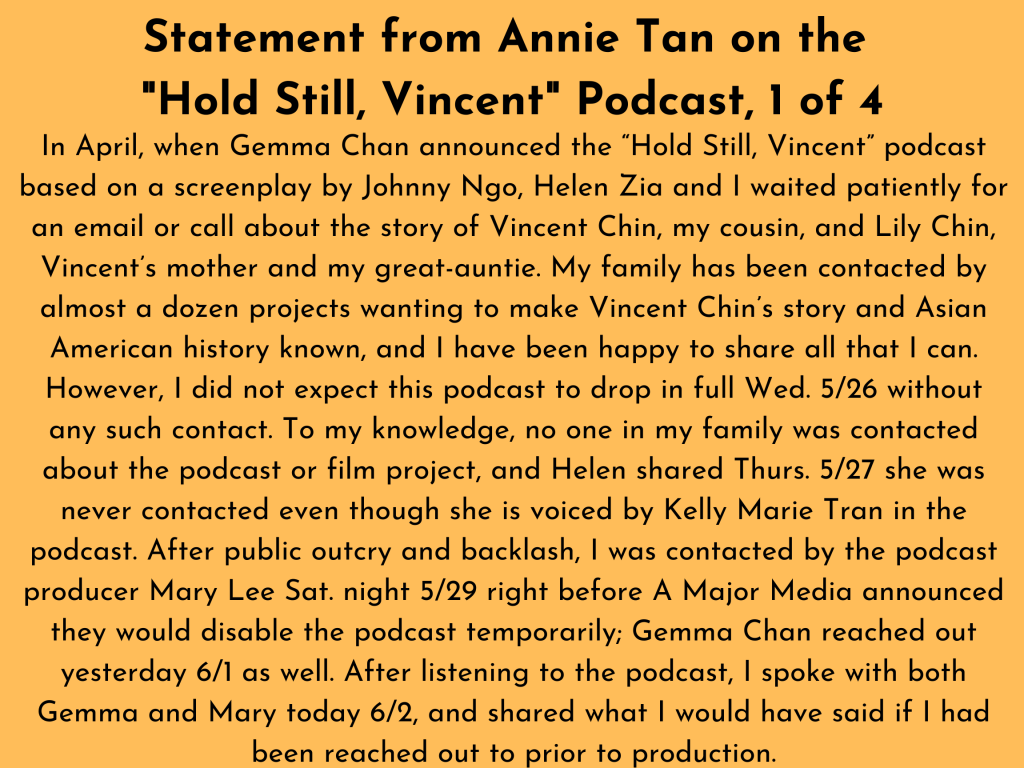
In April, when Gemma Chan announced the “Hold Still, Vincent” podcast based on a screenplay by Johnny Ngo, Helen Zia and I waited patiently for an email or call about the story of Vincent Chin, my cousin, and Lily Chin, Vincent’s mother and my great-auntie. My family has been contacted by almost a dozen projects wanting to make Vincent Chin’s story and Asian American history known, and I have been happy to share all that I can. However, I did not expect this podcast to drop in full Wed. 5/26 without any such contact. To my knowledge, no one in my family was contacted about the podcast or film project, and Helen shared Thurs. 5/27 she was never contacted even though she is voiced by Kelly Marie Tran in the podcast. After public outcry and backlash, I was contacted by the podcast producer Mary Lee Sat. night 5/29 right before A Major Media announced they would disable the podcast temporarily; Gemma Chan reached out yesterday 6/1 as well. After listening to the podcast, I spoke with both Gemma and Mary today 6/2, and shared what I would have said if I had been reached out to prior to production.
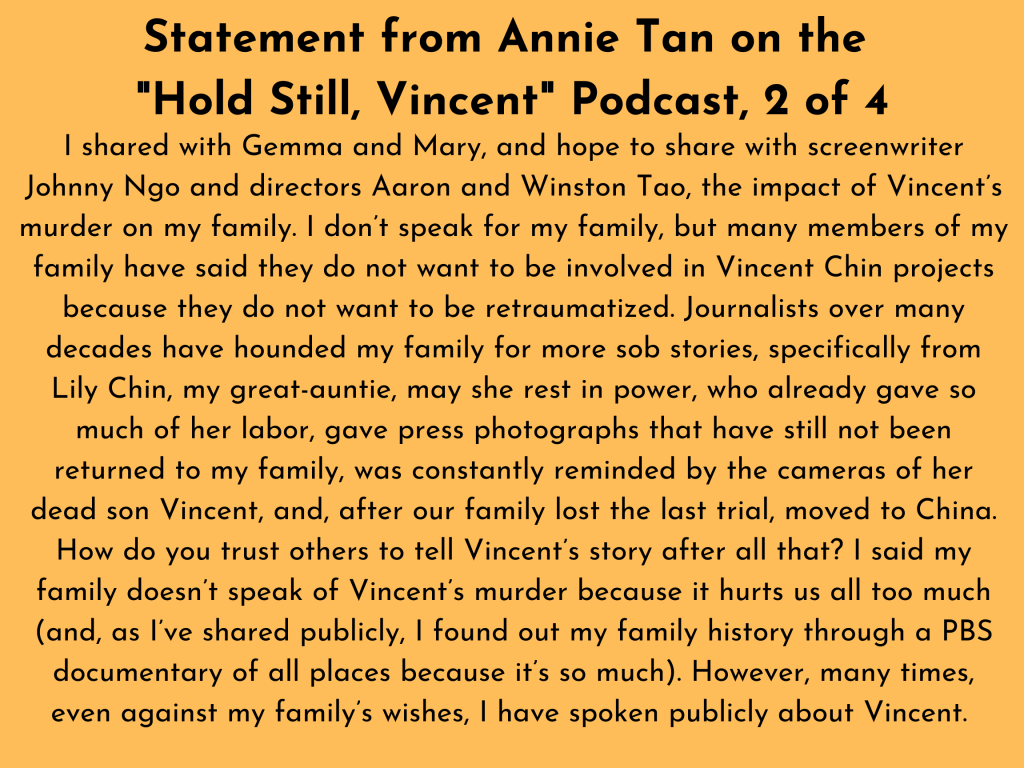
I shared with Gemma and Mary, and hope to share with screenwriter Johnny Ngo and directors Aaron and Winston Tao, the impact of Vincent’s murder on my family. I don’t speak for my family, but many members of my family have said they do not want to be involved in Vincent Chin projects because they do not want to be retraumatized. Journalists over many decades have hounded my family for more sob stories, specifically from Lily Chin, my great-auntie, may she rest in power, who already gave so much of her labor, gave press photographs that have still not been returned to my family, was constantly reminded by the cameras of her dead son Vincent, and, after our family lost the last trial, moved to China. How do you trust others to tell Vincent’s story after all that? I said my family doesn’t speak of Vincent’s murder because it hurts us all too much (and, as I’ve shared publicly, I found out my family history through a PBS documentary of all places because it’s so much). However, many times, even against my family’s wishes, I have spoken publicly about Vincent.
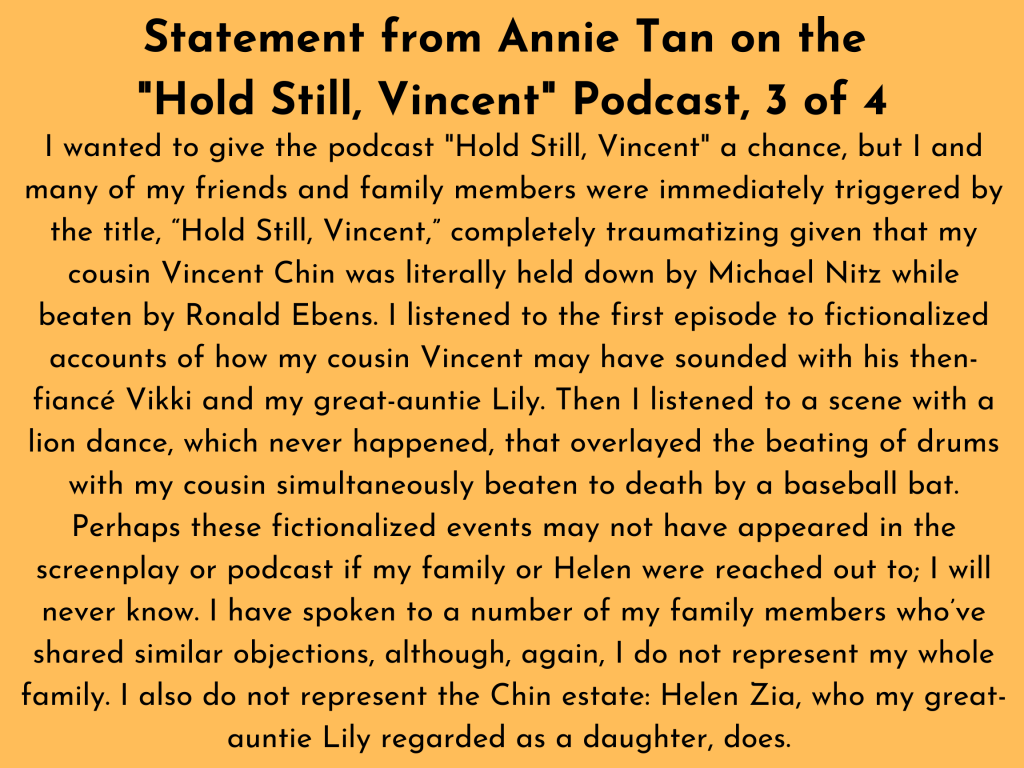
I wanted to give the podcast “Hold Still, Vincent” a chance, but I and many of my friends and family members were immediately triggered by the title, “Hold Still, Vincent,” completely traumatizing given that my cousin Vincent Chin was literally held down by Michael Nitz while beaten by Ronald Ebens. I listened to the first episode to fictionalized accounts of how my cousin Vincent may have sounded with his then-fiancé Vikki and my great-auntie Lily. Then I listened to a scene with a lion dance, which never happened, that overlayed the beating of drums with my cousin simultaneously beaten to death by a baseball bat. Perhaps these fictionalized events may not have appeared in the screenplay or podcast if my family or Helen were reached out to; I will never know. I have spoken to a number of my family members who’ve shared similar objections, although, again, I do not represent my whole family. I also do not represent the Chin estate: Helen Zia, who my great-auntie Lily regarded as a daughter, does.
It is not my role or my family’s role to block other’s storytelling: I want my cousin Vincent Chin’s name and story known. Gemma and Mary both made clear this was a project solely to tell the story of Vincent Chin and Asian American history, not meant to profit, and that any proceeds would go back to Asian American communities, which I trust will happen. However, due diligence should have been paid, which would have been the respectful and bare-minimum steps to reach out to Vincent and Lily Chin’s family, to Vikki’s family, and to Helen Zia who are alive and can speak for themselves. As a storyteller, I know seeking truth is hard and takes time and labor. But if we’re to tell the stories that matter with integrity, we have to do the work, and that means reaching out to those most impacted. As South African disability rights activists said, “Nothing about us, without us, is for us.” I implore the producers and writers of the podcast to apologize with the truth of what happened and make amends with integrity. I hope Hollywood and storytellers everywhere take this lesson on what diversity, representation, and stories should and should not look like.
Many people have asked, in not-so-many-words, “Who are you to write a memoir?” I reply, “I’m writing the story I don’t see anywhere else. And, that I needed.” I’m honored to share, with the #31DaysIBPOC community and world, a draft memoir introduction I’ve been working on. Rest in power, George Floyd, one year ago today.
Draft Excerpt from Introduction of (working memoir title): Speaking Into Existence: A Daughter’s Journey Towards Teaching, Activism, and Her Family
June 2017
5th-grade graduation was looming, and I had to finalize one more thing for my students: what language class each of my students wanted to take in middle school. Sunset Park, Brooklyn, where I teach, is made up mostly of families from the Latinx and Asian diasporas, and while I hoped Chinese or Arabic would be available classes for my students’ families, only romance languages were on this list: Spanish, French, Italian. At least Spanish was a choice for my Latinx students; New York City schools was a long way from teaching the 600+ languages our students and their families speak. Including my own.
I went up to each student for their answers. “I’m going to learn Italian,” S, a Mexican student, responded. “Spanish is stupid.”
My eyes involuntarily teared up. I knew that feeling of shame and embarrassment too well. I had to interrupt it.
“S, what language do you speak at home?” I knew the answer, of course, after parent-teacher conferences:
“Spanish,” S replied.
I nodded my head. My next question was what I wished I had been asked in fifth grade:
“Does your mom know any English?”
“No—”
I was in. “Your mom only speaks Spanish, right? And how is your Spanish?”
“Um, I don’t know much.” S began to hunch inward, regretting that she’d said anything in the first place.
“Exactly!” and I continued: “So is your mother’s language stupid? Is your family’s? NO! What do you think will happen when you’re an adult and you can’t speak Spanish? Do you think you’ll be able to speak to your mom?”
“No—”
“Exactly! The research says your brain is primed towards learning languages in your early teenage years, not later, not as an adult, NOW.”
And without stopping I began to project my own experience onto S:
“I didn’t learn Chinese at your age, and I wish I did or got the chance to, because then I would be able to speak to my parents, and now I can’t speak to them.”
I didn’t stop to breathe as I emphatically pointed my index finger towards my face. “Learn your parents’ language because you don’t want to end up like Ms. Tan not being able to speak to her own parents!”
S looked like she was about to cry. I realized I had unloaded too much on her, so I stepped away to the next student, willing my body to calm down.
I’d made some iteration of this stump speech dozens of times: I was often the first teacher in my students’ lives to do so. But this time, for some reason, the speech stung.
It was the word stupid that got me. I knew that feeling too well.
December 2020
“Hey, isn’t it time for your Cantonese class?” Winnie shouted from the kitchen.
I looked up bleary-eyed at the clock. 5:58.
“It’s Wednesday, right?” I nodded, breaking my daze. I had just texted my students’ parents Monday night that, because of COVID-19 cases, school was closed in-person Tuesday, texted Tuesday night that we’d reopen in-person Wednesday, and just finished my round of texts that we had a snow day Thursday. I was exhausted.
“It’s really nice to hear you, your teacher and your classmates talking in Cantonese. I don’t really hear Cantonese anymore.”
“Yeah, I know. Me neither.” It was like Winnie was egging me on to go to class, even though I wanted to make an excuse again not to show.
The only times I spoke Cantonese were in class, in Chinatown buying groceries, or with my parents. The calls started after I left home for college, and each day was the same: “Nee hak faan mee a?” In Toisan, or, more specifically, Hoiping: have I eaten yet?
“Sik6 zo2 la,” I wearily replied in Cantonese, the lingua franca of my Manhattan Chinatown but not my parents’ hoeng1 ha2 village languages. Cantonese is the closest language I have to my parents, a language I could at least grasp with a Cantonese romanization system called jyut6ping3, with 6 tones that would change the meanings of words if interchanged; sei3, the number four, was unlucky because if said like sei2, like a question, I was speaking of death.
Of course I know how to say my favorite Cantonese dishes, Mom shows her love through food, after all, but for the phone calls there are certain food words I’ve memorized for my dad: gaai1 for chicken, saai1 gaai3 lan2 for broccoli, faan6 for rice. Other words take longer to remember, if I knew them at all: faan1 ke2 for tomato, and I definitely don’t know how to say some other stuff in my fridge, like salsa, oatmilk, or pickles. And I’m still flipping words: a habit from childhood I never kicked is to say I want more jau4, oil, instead of zap1, sauce, something I still get ridiculed for.
I continued with the routine update: “My 5th-grade students were good today,” wanting really to say to my dad that no one turns on their cameras over Zoom and that I’m mostly talking to myself when I teach. But I don’t have the words to explain.
My dad and mom speak at least four Chinese languages: Cantonese, Toisan, Hoipingwa, and Mandarin, and are able to read, listen to, speak and write in Chinese characters. At home growing up, as with many Chinese immigrants my parents didn’t say much. But when they spoke they slurred their languages, so I mixed them up too. The ABC, American Born Chinese, kids in my Chinatown elementary school, didn’t know which Chinese languages I was mixing up, wouldn’t be able to understand me, then made fun of my accent and tones. I didn’t understand that then, though, why I was being mocked: I must have been stupid, so I stuck to English, the language I did know, not understanding that would put me worlds apart from my family. I only learned jyut6ping3 at 19, when I went to Hong Kong to study abroad, long after the shame had solidified in me, and long after languages were most malleable in my brain.
Even though my parents have been in America almost four decades, they never learned English, never needing it in the Chinese sweatshops, bakeries or construction companies they worked at. And even though I had my brothers, I was the one at the Medicaid and Social Security and doctors’ offices reading, listening, speaking, and writing in English, the only language I was fluent in, and using my meager Cantonese and bodily motions to translate back to mom and dad.
Mom figured out to use number words with the Arabic numerals scrawled in her checkbook to write checks and can make out maybe 50 written words in English, her English language levels similar to my Chinese language levels. If she or Dad really don’t understand something and us kids aren’t around to translate, Mom goes to a Chinatown social service center for help with English paperwork. Or takes a photo and sends it to someone on WeChat to translate.
Winnie, my oldest friend and now roommate, understood all this well: she didn’t speak Hoiping, but she was Toisan and spoke Cantonese, which I would find out maybe a decade after we first met in 4th grade. I looked back at her hopeful face as she marinated a black bean garlic pork dish. Suddenly I was grateful for her presence in this old Chinatown apartment on Broome Street, my childhood home, just two blocks from where Winnie grew up, and now our home together.
I reluctantly flipped to my Google calendar for the Cantonese Zoom class link. I knew, after taking graduate classes in 2014 to be an English-as-a-New-Language-teacher, that my brain is no longer primed to learn another language like when I was in sixth grade. Back then, Winnie and I took Spanish classes; we were focused on getting good grades, and so we actually learned how to conjugate and pick up Spanish vocabulary and sentence structures. I wasn’t wanting at all then to learn Chinese. Now both of us read more Spanish, a language which shares roots with English, than any Chinese language.
I got on the Zoom call, said “hello a Jaa-net” to my Cantonese teacher. Janet, who’s been forever patient in all the times I’ve been 20-30 minutes late to class, when I always leave mid-class to “use the bathroom” aka scroll through Twitter for a while because I can’t focus on the Cantonese I’ll never retain, when I promise to do the “homework” that will take 20 minutes to do which I don’t do, and say “haa6 ci3 gin3,” which sometimes I won’t because I’ll find some excuse to ditch class because of the pure exhaustion of teaching.
I know maybe 300-500 spoken words in Cantonese, those few hundred the ones I’ve held onto since childhood and the building blocks for the most basic communication with my parents. I know I need to learn at least 3,000 words in order to get fluent. Until recently, I didn’t know how to access the tools to get there: it’s only been in the past five years that Cantonese apps and dictionaries like Pleco have existed.
I wonder when I will have time to practice my Cantonese, given how exhausting teaching is, because I don’t have a lot of time left. Every day I wonder when my next relative will pass, another relative whose stories will not be passed onto the next generation. I think about how many stories I will never know, because I don’t share the same language as my grandmother and my cousins and aunties and uncles. And parents. I will never know fully how my parents got to America, where my extended family ended up, the time family spent in China and Vietnam and America and elsewhere.
What’s the use? I’m never going to learn enough to talk to my parents, let alone read the Chinese newspaper. So what’s the point? Jau5 me1 je3 jung3 a?
Even if I spoke the languages, though, would my family even tell their stories? I found out by pure accident, after all, while watching a PBS documentary, that I am related to Vincent Chin, a man murdered by two white men who shouted anti-Asian sentiments at him, whose murder led to an Asian American movement, and whose legacy pushed me to be the activist I am today.* Even if great-auntie Lily, Vincent’s mother and my great-auntie, were alive, would I be able to get her story, of how she fought back, how her words and courage led to that movement?
But then again, that one family story, what I know of it anyways, changed my life. I knew the power of stories, that’s why I began telling stories in the first place. And, if I could find out more, maybe another story could change someone else’s life.
After Cantonese class, I check my phone and see a bunch of texts from parents about the snow day.
“Ok muchas Grasias buenas noches” with a sleepy emoji.
“De nada,” I reply.
“Gracias por todo,” another parent texts.
I sit back, readying myself for another remote day. The building may be closed, but school is always on.
Later I get a call from one of my students’ parents. She speaks to me in Toisan, and I speak back, my Toisan broken.
“Nee hai hoisan a?
Keoi ho hoi seem a, keoi ho zung yi nee doo keoi lo sloo a.
Keoi ho seung hok zung moon a.”
I’m the first Toisan teacher her child’s had.
She is so happy I am her teacher.
She really wants to learn Chinese now.
I breathe.
*If you’d like, you can listen to me tell this story “Remembering Vincent” for The Moth. Then come back for the memoir one day when it is published! Thank you so much for reading.
#31DaysIBPOC: Celebrating the teacher voices of Indigenous, Black, and People of Color This May! Hosted by Kim Parker and Tricia Ebarvia
*This blog post is part of the #31DaysIBPOC Blog Series, a month-long movement to feature the voices of indigenous and teachers of color as writers and scholars. Please CLICK HERE to read yesterday’s blog post by Narin Ramani (and be sure to check out the link at the end of each post to catch up on the rest of the blog series).
My mom has a nickname for me, 八 a baat6. In Cantonese, it means busybody, curious, always asking questions. It’s kind of got a negative connotation.
And I had to suppress that curiosity, asking all of those questions, because when you’re born a kid of immigrants, you’re taught a guiding set of principles on which to live on. Keep your head down. Learn English, go to school, get good grades, go to college. Marry yourself a nice Chinese husband. Have kids, buy a big house for yourself. And keep quiet.
And so these are all the things I learned, and everyone around me believed them, because I was born and raised in Manhattan’s Chinatown, which is bustling with Chinese immigrants and kids of immigrants like me. My mom worked odd jobs in sweatshops, and in Chinese bakeries, my dad worked six days a week as a construction worker, and when he’d come back on Sundays, me and my brothers would take turns massaging his back. While doing all of this, I’m also trying to grapple with being both Chinese and American. And so I’m in fifth grade, watching a soccer match with my parents. And it’s the US versus China. And I asked my dad, “Who are we rooting for?”
“Of course, China.”
“But we’re here in America?” I thought.
I couldn’t ask that question though, because when you’re growing up here, you know that in that tiny Chinatown apartment you’re not supposed to speak up, because you’re just going to cause a ruckus.
But I found my ways to figure out this identity issue. When I was 13, I was so excited to watch a PBS documentary all about me: “Becoming American: The Chinese Experience.” Before that, I’d only seen three people who looked like me, Jackie Chan, Trini, the Yellow Power Ranger, and Mulan a cartoon character.
So I’m so excited to watch these last 20 minutes, which talks about people marching and protesting, people who look like me! They’re holding clever signs in English. They’re chanting in English. I’ve never even seen anyone in Chinatown march before for anything! What was so big that all of these people would go on the street and risk their identities and their lives?
They were marching for this man named Vincent Chin. Vincent Chin in 1982 was a Chinese American man who was beaten to death. He was beaten to death by two white laid-off auto workers who assumed he was Japanese during the auto workers crisis in Detroit, where Japanese companies were booming, and people thought, the Japanese were stealing their jobs. They fought the guys, chased Vincent Chin, and beat him to death with a baseball bat at his bachelor party. Instead of going to his wedding, his wedding guests went to his funeral instead the next week. The two guys who killed Vincent Chin never served a day in jail and paid $3,000 for this man’s death.
And so all of these groups of people: Chinese people, Korean people, Japanese people, Filipinx people were now saying, “If this could happen to this guy Vincent Chin, this could happen to any of us.” And so they began to rally together. And for the first time for many of them, they came together under the term “Asian American.”
Asian American. I never heard that term before, and Vincent Chin must have been so important if he had brought all of these groups together.
So my mom happens to walk into the room as I’m watching this documentary. And I’m thinking she’s about to yell at me for being lazy on the couch, and she points the screen she looks up and in Cantonese says, “That’s your family.”
What?!
I have all of these questions. Who is he? How is he related to me? Was he like a cousin of a cousin of a cousin? Have I ever met him? No I haven’t met him, because I wasn’t born yet in 1982. But I’m wondering, like, what happened?
I look up at my mom’s face and there’s just pain and anguish in her eyes. She didn’t look like she had wanted to tell me this, but I think she felt she had to tell me.
How could I ask all these questions? How could I ask about a murdered man in our family? I had nothing to say at that moment and I just decided: I’m not going to confront my mother about this. I don’t want to hurt her.
So I decide to do research. I started looking up articles online. I find out there’s a documentary called “Who Killed Vincent Chin?” I look at all the New York Public Library branches and I can’t find a single copy. But luckily, when I was a freshman in college, the Asian American Alliance screens the movie.
The movie featured heavily Vincent Chin’s mother, Lily Chin. Lily Chin went all over the nation and on the Phil Donahue show crying out, “I want justice for my son.” She’s featured at her house in the suburbs of Detroit feeding her relatives, making fun of the relatives and making jokes, trying to set up the filmmakers with boyfriends. And she was speaking in my native tongue Toisanese. At some moments during the documentary you could see Lily Chin trying to hold back her tears, because at the sight of the cameras she was always reminded of her dead son Vincent Chin.
And I couldn’t help but cry myself, because this woman looked so much and sounded so much like my grandmother, my maternal grandmother. And she was rallying and she was protesting. She was nothing like any of the Chinese woman I’d ever seen before.
And I thought to myself, I have to find out who Lily Chin is, because if Lily Chin is indeed my family, and she’s related to me, then I, I have an example in my family of someone who spoke up. I could be a 八 baat6 again, to be a busybody curious and be proud of that, you know?
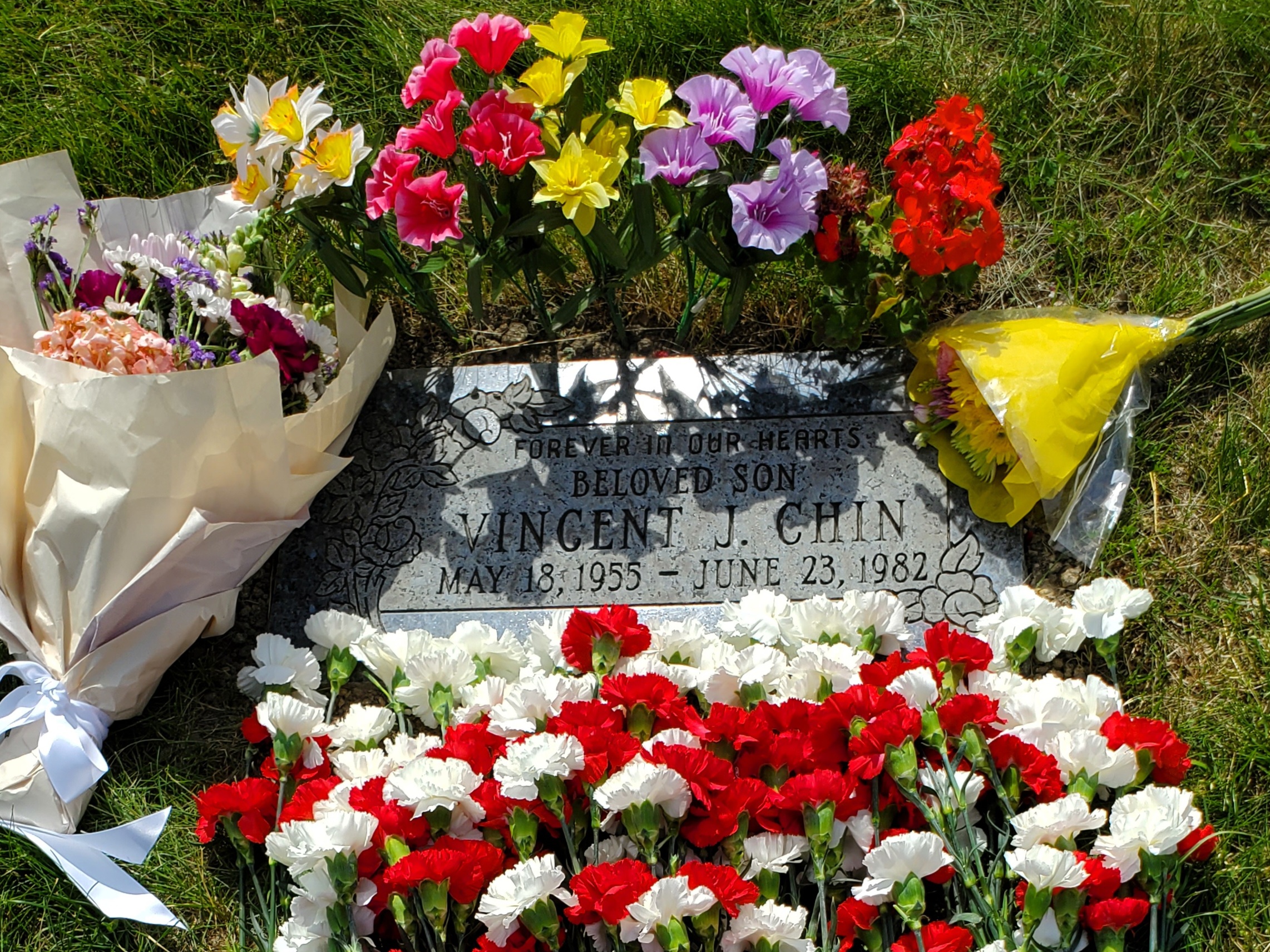
So now I’m like, I have to find out who Lily Chin is and I had to find out who Vincent Chin is. So I go to the only place where I think I’ll get a full answer. The city where Vincent Chin lived and died, Detroit. I took an eight-hour Megabus to Detroit. My friend picked me up, and I asked her if we could go to Forest Lawn Cemetery, to see Vincent Chin’s grave. She drives us, and we find Vincent Chin’s name on a tombstone, Lily Chin’s name on a tombstone, and Lily Chin’s husband’s name on a tombstone.
They’re no longer ghosts: they’re right below my feet. And I’m finally going to know how these people are related to me, and why this means so much to me.
I go the next day to my relatives’ house. We’re eating 12 dishes of meals, I’m looking through 30 photo albums of my family. I see pictures of my mom and dad with matching perms in the 1980s.
And so I asked my relatives, “Can you help me make a family tree? I want to know more about my family.”
So we start with my grandmother’s line. My grandmother had a brother and nine sisters. My great-auntie said, “The second sister on this list is Lily Chin.” So now I know Lily Chin is my grandmother’s sister, Lily Chin is my mother’s first auntie and Vincent Chin is my mother’s first cousin.
So I asked my auntie, “What happened to Lily after Vincent died?”
She tells me. “Well, when Vincent died, Lily was all alone in Detroit. So your grandmother and I, Lily’s sisters, flew to America from China to support her. Your mom and dad had married in China so your dad came soon after. They all found work in New York. And that’s how your family ended up in Manhattan’s Chinatown.”
I thought about this for a while.
My grandmother had brought my parents to America from China, which had a one-child policy at the time, and I am the second child of three.
If Vincent Chin had not been killed, Lily Chin may never have been alone in Detroit.
My grandmother may never have flown to America to support her.
She may never have brought my parents to America.
And I may never have been born.
That knowledge made my life now precious to me. And I only knew this because I dared to be a 八 baat6: curious, asking questions after 10 years of trying to find this answer.
And so every single day of my life now I march on. Just like Lily Chin marched on, just like the thousands of people who marched for my cousin Vincent Chin.
But that message as a kid that lesson I learned so well, to not speak up, it’s always in my head. I constantly have to stop that voice, that voice that tells me, “Don’t go on that bullhorn Annie. Don’t go to those protests, don’t write those articles. Don’t fight for your special education students.”
And I tell that voice, every single day. No, I have to. I have to fight.
Because my cousin Vincent Chin didn’t die for nothing. My great-auntie Lily Chin did not go all over the nation and speak out for nothing.
And I was not born for nothing.
Please send Asian American Pacific Islander organizations doing the work on the ground some love right now by donating or volunteering time:
Free Minds Free People Conference, July 2013. Photo Credit: Sarah Jane Rhee.
I first met Karen Lewis July 2013 as a new member of the Chicago Teachers Union and excitedly stood for the above photo. I met Corky Lee two summers later at NQAPIA 2015, where I nervously thanked him for taking iconic photos of the Vincent Chin case, which I’ve used to piece together family history.
Both those humans, over the years, have been friends to me, sharing news, positivity, warmth, and wisdoms won. We’ve sat and stood in celebratory moments, in marches, at parties, dances, weddings. We’ve nodded heads in knowing quiet at protests and rallies. And we had our quiet moments where we just talked and talked about everything.
Karen and Corky both knew to listen intently, to be present, and to share. They tried to know everyone they came across, really know them. They were warm, funny, cranky, fierce, opinionated, protective, loving.
They cheered on my fights, whether for more for my students, for my colleagues, for my growth with my family and history, and just for my life.
They wanted more for us. To leave this earth better than it was before them.
When I lived in Chicago, I’d see Karen leading always, with that quiet knowing, wisdom earned from years teaching and living on this earth. She knew what to say and when. She always asked: “Does this unite us? Build our power? Make us stronger?” which became our organizing cries. Those words run through my head always and remind me to do better, be better. Is this for our students, and for the schools they deserve? She reached out when things were rough, asking me how I wanted to fight back, and knowing I’d find my way. I loved her for that, that she took that time.
Karen, as the President Emerita of the Chicago Teachers Union, led this Red for Ed movement, was our icon, our beacon of light, and made our lights shine across the world, so that each and every educator knew they had power and leverage, the courage to fight back for the schools our students deserve. It was not scary to say aloud Black Lives Matter or to tax the rich or demand housing for all, because those statements were just true and real.
I will never forget the tens of thousands of us marching the streets of Chicago, all in red, fighting for justice. The red lives in my blood now, forever reminding us we have the power to fight back.
On the cusp of a 2012 Chicago Teachers Union Strike. Powell Photography.
Karen would have been mayor of Chicago if it weren’t for the brain cancer. I’ve done a lot of canvassing, but none as easy as getting Karen on the ballot for Chicago mayor in 2014. (I once went on a CTA Western Bus and filled up my page with signatures in ten minutes.) It was such a heartbreak when Karen had to drop out: she would have done so much good as Mayor, but continued to fight the brain cancer for years after, succumbing last night to it.
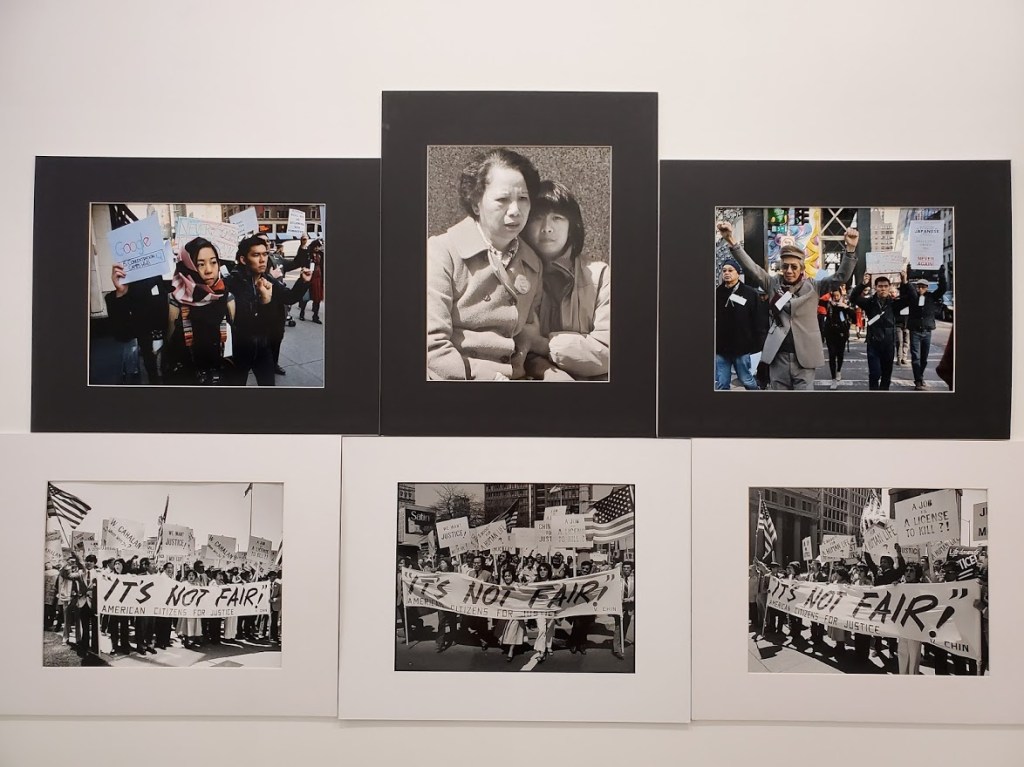
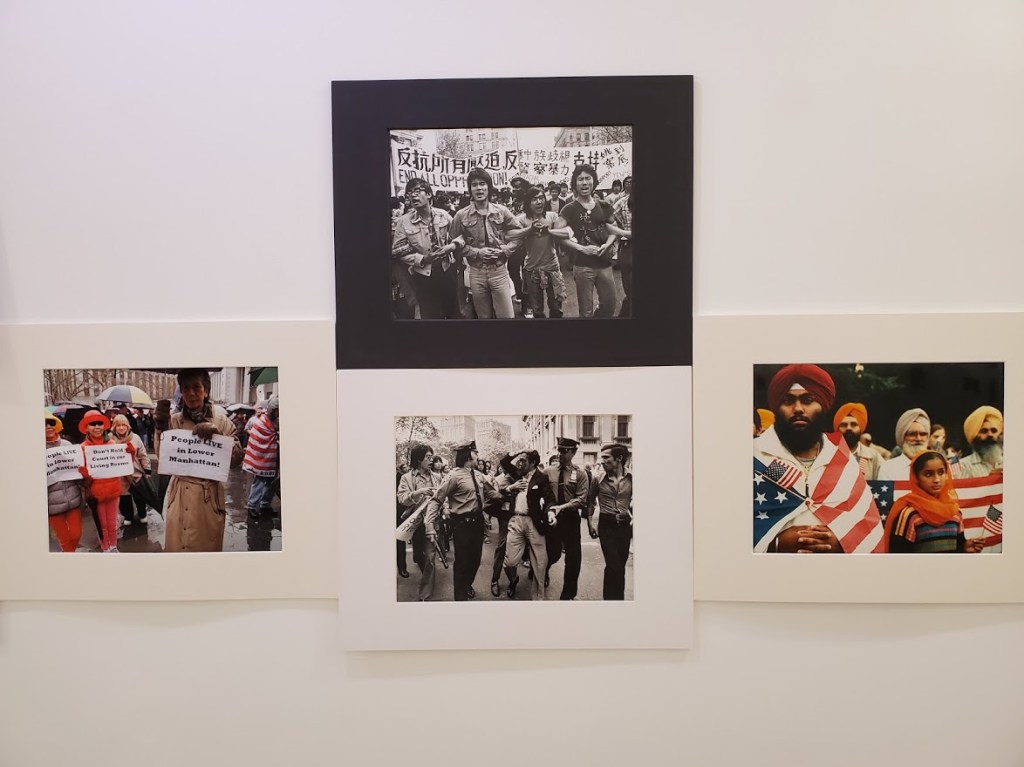
Retrospective of 50 years of Corky Lee’s Photos, Eldridge St. in Chinatown, Sept. 30th, 2020. The top center photo in the first image is my great-auntie Lily Chin, held by my cousin, as they mourn the loss of my cousin Vincent Chin and continued to fight for justice for Asian Americans everywhere.
When I moved back to New York in 2016, I immediately kept bumping into Corky Lee in Chinatown, a place he loved so much, and where his funeral procession drove through this Saturday. Corky was everywhere, whether helping Chinese Americans learn their genealogy, their history, exhibiting his photos of Asian American history spanning 50 years, or just chilling at Silk Road Cafe, looking at photo prints or old rolls of film for more of Asian American history to unlock. You never made plans with Corky: he was just always there. He WAS our Asian American Photographer Laureate, documenting our histories and our lives.
I don’t have any photos with Corky because he was always there taking the photo (In fact, after the 2015 NQAPIA dinner, he messaged me, “Spent all too much time photographing that there was little or cold food left on table……”). Corky had so much more he wanted to do. But, he made sure the ABC, American Born Chinese, generations like us knew about important events, knew our history, and put things in context. AND he linked us to each other. He made sure we would be tied to one another long after he was gone.
Corky Lee’s funeral procession, Feb. 6th, 2021.
Corky shouldn’t have died of COVID19. We’re approaching half a million deaths to COVID19 and we’re pretending like everything should go back to normal when it’s not normal and will never be normal again.
We stand on the shoulders of giants, giants who paved the way for us to be where we are today. Who knew what justice meant, who were imperfect human beings who loved and fought fiercely. Who continue to remind us everyday to fight back, hard, for a better world.





 Annie Tan